New study – Ocean warming associated with rapid declines in productivity and elevated risk of fish stock collapses
 Our work led by the PhD student Mathieu Pelissie just got published in Science Advances. In a nutshell we found:
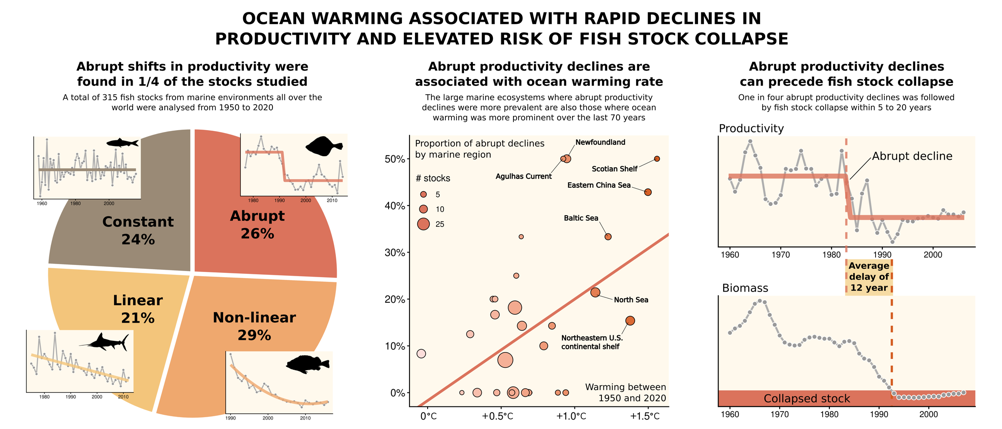
– More than 25% of the marine fish populations studied experienced abrupt changes in productivity since 1950.
– Rapid productivity declines were substantially more common in marine regions experiencing the highest warming rates
– Fishery collapses were frequently preceded by abrupt productivity declines several years earlier, offering a potential early warning for fishery managers.
You can read more in the associated press release below.
Sustainable fishery management seeks to adjust fishing pressure in response to changes in the abundance and resilience of fish populations. The mathematical models used to guide management assume that such change is gradual. However, a new study of marine fisheries throughout the world since the middle of the 20th century finds that fisheries frequently show abrupt shifts in productivity rather than smooth trends. More worryingly, marine regions with the highest rates of ocean warming also show more frequent abrupt declines in fisheries and these abrupt declines commonly precede more serious fishery collapses. This research was led by scientists from the French National Centre for Scientific Research (CNRS), the University of Montpellier, and Cornell University. It was published in the journal Science Advances on Wednesday, September 2, 2026.
The history of marine fisheries provides examples of once numerous fish or invertebrate populations that declined rapidly over the course of a few years. However, such abrupt declines, and the economic consequences that follow, are difficult to predict in advance and are rarely considered in the models used to manage fisheries. This study demonstrates that such rapid changes are more common than previously realized and attempts to identify the causes and consequences of such abrupt population change.
To achieve this goal, the scientists gathered data on annual population size or “biomass” and the amount of fish harvested from 315 marine fish populations from throughout the world from 1950 – 2020. These data, from the most complete database of marine fish populations in the world, were then examined for evidence of abrupt shifts in productivity or the rate of population growth expected to have occurred in the absence of fishing. Results showed that more than 25% of fish populations had experienced abrupt shifts in productivity, with more than half of these populations experiencing abrupt declines in productivity.
Certain fish species demonstrated a higher tendency toward such abrupt shifts – notably the family of fishes which include Atlantic cod, a species which has experienced multiple economically damaging population collapses since the 1980s. Still more surprising was the finding that abrupt productivity declines were most frequent in marine regions which have experienced the fastest rates of ocean warming. Putting together species characteristics, along with changes in temperature and fishing pressure, warming rate was indeed found to be the main factor explaining the occurrence of abrupt productivity declines.
The researchers also examined the consequences of such abrupt productivity shifts on the sustainable management of fish stocks. The researchers compared the frequency of stock collapses – defined as a stock declining to less than 25% of its previous average population size – among populations with smooth changes, abrupt positive shifts, and abrupt negative shifts. They found that a stock was twice as likely to collapse if it had experienced abrupt declines in productivity. On average, abrupt declines in productivity preceded stock collapse by 12 years. This time lag provides a window for fishery managers to intervene to prevent collapse – if the abrupt shift can be identified quickly enough.
With ocean warming projected to continue throughout much of the world’s oceans, these results suggest that fish population models which assume stability may increasingly fail to predict rapid changes impacting fisheries. More broadly, the methods developed in this study for detecting and characterizing abrupt change are likely transferable to other biological contexts where life may change more suddenly than expected.
Finally, this study demonstrates the importance of open data sharing at a global level. The type of long-term data used here often requires steady support and funding from public institutions. Otherwise, this valuable information might be lacking as it is unfortunately the case in too many regions particularly vulnerable to the consequences of global change, making management all the more complex in such context.